
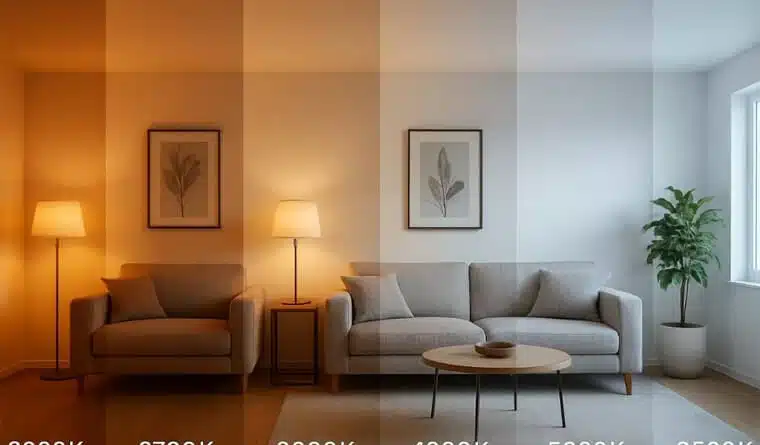
LED Light Bulb Color Temperature Guide and How to Choose the Correct Kelvins for Your Spaces
Basics About LED Light Bulb Color Temperature Guide
A Complete Resource of light bulb color temperature guide for Understanding Kelvin, CRI, and Choosing the Right Lighting for Every Space.
Selecting the right LED lighting involves more than choosing a fixture or wattage. The color of the light itself plays a critical role in how a space looks, feels, and functions. Light color influences mood, productivity, visual comfort, and even how accurately objects appear.
For homeowners, contractors, electricians, and facility managers, understanding color temperature and color rendering is essential when selecting lighting products. This guide explains the fundamentals of LED light color temperature, how Kelvin works, what CRI and R9 mean, and how to choose the best lighting for residential and commercial environments.
Understanding Light Bulb Color Temperature
What Is Color Temperature?
Color temperature describes the appearance of light emitted from a source, measured on a spectrum that ranges from warm yellow tones to cool bluish hues. This value is expressed in Kelvin (K).
Lower Kelvin values produce warm, amber-like illumination, while higher Kelvin values generate cooler, daylight-like light.
Most LED fixtures are available in multiple color temperatures, allowing users to select lighting that best matches the function and atmosphere of a space.
Another common specification is Correlated Color Temperature (CCT). CCT represents how closely an LED’s light output matches the color of a theoretical heated object known as a black-body radiator. In practical terms, CCT simply refers to the Kelvin rating used to describe LED light color.
Typical LED color temperatures range between 2200K and 6500K, covering the spectrum from warm ambient lighting to bright daylight illumination.

How the Kelvin Scale Works
The Kelvin scale is a scientific measurement of thermodynamic temperature, named after physicist William Thomson, also known as Lord Kelvin.
Unlike the Celsius scale, Kelvin begins at absolute zero (0 K), the theoretical point where all molecular motion stops. Absolute zero corresponds to −273.15°C.
Although this scientific concept originates from physics, it provides a useful framework for describing light color. When a theoretical object is heated, it emits different colors depending on its temperature.
As temperature increases, the color shifts along the visible spectrum:
- Lower temperatures → reddish or amber light
- Moderate temperatures → neutral white light
- Higher temperatures → bluish white light
Natural sunlight follows a similar pattern throughout the day. Early morning and sunset produce warmer tones around 3000K, while midday sunlight approaches 5500K–6500K, appearing much cooler and brighter.
Understanding LED Light Colors
Warm Light vs Cool Light
LED lighting is commonly categorized into warm, neutral, and cool color ranges.
Warm White (2200K – 3000K)
Warm lighting produces a soft glow with yellow or amber undertones. This type of light creates a relaxed and comfortable atmosphere, often associated with traditional incandescent bulbs.
Warm white lighting is typically used in:
- Living rooms
- Bedrooms
- Restaurants
- Hospitality environments
- Residential spaces designed for relaxation
Neutral White (3500K – 4100K)
Neutral lighting provides a balanced white tone that is neither too warm nor too cool. It offers excellent visibility without appearing harsh or sterile.
Neutral white is frequently used in:
- Offices
- Kitchens
- Retail stores
- Educational environments
- Healthcare spaces
Cool White / Daylight (5000K – 6500K)
Cool white or daylight lighting appears crisp, bright, and slightly bluish. It closely resembles natural daylight and enhances visibility in environments where clarity and productivity are essential.
These temperatures are commonly used in:
- Warehouses
- Outdoor lighting
- Parking lots
- Industrial facilities
- Large commercial spaces
Understanding CRI, R9, and Color Rendering
Color temperature describes the appearance of light, but it does not indicate how accurately colors appear under that light.
That is where CRI and R9 come into play.
What Is CRI (Color Rendering Index)?
CRI measures how accurately a light source reveals the true colors of objects compared to natural sunlight.
The scale ranges from 0 to 100:
- CRI 90–100: Excellent color accuracy
- CRI 80–89: Good color rendering (typical for many LEDs)
- CRI below 80: Poor color reproduction
Traditional incandescent and halogen lamps typically achieve CRI values above 95, while early LED or HID lighting often had much lower scores.
Higher CRI lighting is especially important in environments where color accuracy matters, such as:
- Retail displays
- Photography studios
- Hospitals
- Design studios
- Museums
What Is R9?
CRI is calculated using eight pastel color samples (R1–R8). However, these do not include saturated red tones.
R9 measures how well a light source reproduces strong red colors, which are critical for accurate rendering of:
- Skin tones
- Food products
- Wood materials
- Fabrics
- Artwork
A high R9 score significantly improves visual quality. Many modern lighting standards require R9 values above 50 for improved color accuracy.
Why CRI and Kelvin Are Different
Kelvin describes the color of the light source itself.
CRI and R9 describe how objects appear under that light.
Because these measurements are independent, a light can have a cool color temperature yet still render colors accurately—or poorly. Both metrics should be considered when evaluating lighting quality.
Typical LED Color Temperature Ranges
| Color Temperature | Light Appearance | Typical Applications |
|---|---|---|
| 2200K – 2700K | Very warm amber | Residential ambiance, restaurants |
| 3000K | Warm white | Living rooms, bedrooms |
| 3500K | Neutral white | Offices, retail |
| 4000K | Cool neutral | Kitchens, workplaces |
| 5000K | Daylight white | Warehouses, garages |
| 5700K – 6500K | Bright daylight | Outdoor and industrial lighting |
Choosing the Best Color Temperature for Residential Spaces
Lighting inside a home should balance comfort with functionality. Different rooms serve different purposes, and each environment benefits from a specific lighting tone.
Living Room
The living room serves as a central gathering space. Lighting should feel warm, inviting, and comfortable while still providing adequate brightness.
Recommended temperature:
2700K – 3000K
Dimmable lighting works especially well here, allowing homeowners to adjust brightness for different occasions.
Kitchen
Kitchens require brighter lighting for cooking, food preparation, and cleaning tasks. Clear illumination improves visibility and safety.
Recommended temperature:
3000K – 4000K
Many kitchens combine warm ambient lighting with cooler under-cabinet task lighting.
Bathroom
Bathroom lighting should be both comfortable and functional. Clear illumination helps with grooming tasks such as shaving or makeup application.
Recommended temperature:
3000K – 4000K
LED vanity lighting often provides frontal illumination to reduce shadows on the face.
Bedroom
Bedrooms are spaces designed for relaxation and rest. Soft, warm lighting helps create a calm environment.
Recommended temperature:
2700K – 3000K
Avoid overly bright or cool lighting that may feel stimulating before sleep.
Home Office
Workspaces benefit from slightly cooler lighting that promotes concentration and reduces eye strain.
Recommended temperature:
3500K – 4000K
Balanced white lighting helps maintain productivity during long working hours.
Garage or Workshop
Garages and workshops require strong, functional lighting for detailed tasks and equipment operation.
Recommended temperature:
4000K – 5000K
Daylight tones improve visibility and clarity.
Best Color Temperatures for Commercial and Industrial Spaces
Commercial environments prioritize productivity, safety, and visual clarity.
Office Buildings
Offices benefit from neutral lighting that reduces fatigue while maintaining focus.
Recommended temperature:
3500K – 4000K
Retail Stores
Retail lighting should highlight merchandise and present products accurately. Slightly cooler lighting often improves visual appeal.
Recommended temperature:
4000K – 5000K
Warehouses
Warehouses require strong illumination for safety and efficiency. Bright high bay lighting helps workers identify inventory and navigate large aisles.
Recommended temperature:
5000K
Gyms and Indoor Sports Facilities
Athletic environments benefit from energetic lighting that resembles daylight.
Recommended temperature:
4000K – 5000K
This range improves visibility and contrast for fast movement.
Factories and Manufacturing Facilities
Industrial environments require high visibility for safety and precision.
Recommended temperature:
4000K – 5000K
Cooler lighting improves focus and reduces visual fatigue during long shifts.
Schools and Libraries
Educational environments benefit from balanced lighting that supports reading and concentration.
Recommended temperature:
3500K – 4000K
Outdoor Lighting Color Temperature
Outdoor lighting often uses cooler tones because they produce higher brightness and improved visibility.
Common outdoor applications include:
- Parking lot lights
- Street lighting
- Security lighting
- Building perimeter lighting
Recommended temperature:
5000K
This color closely resembles natural daylight and provides excellent nighttime visibility.
Tips for Choosing the Right LED Color Temperature
Selecting the correct lighting often comes down to preference and application.
Helpful guidelines include:
- Use warmer tones for relaxation areas
- Use neutral tones for everyday living spaces
- Use cooler tones for work environments
- Consider CRI and R9 values for color accuracy
- Test a sample fixture before purchasing large quantities
Installing one fixture first allows you to evaluate how the lighting performs in the actual space.
Final Words
Understanding LED color temperature allows you to design lighting that enhances both the appearance and functionality of a space.
Warm tones create comfort and atmosphere. Neutral lighting balances clarity and comfort. Cooler daylight tones maximize visibility in commercial and industrial settings.
By considering Kelvin, CRI, and the intended application, it becomes much easier to select the right lighting solution.
Choosing the correct LED lighting does more than illuminate a space—it transforms it.
